Is a Recumbent Trike Really More Comfortable? Ergonomics & Muscle Science Explained
Science-backed breakdown of why recumbent trikes are more comfortable than upright bikes: weight distribution, muscle activation, pressure points, and posture. Learn how ergonomic trikes reduce neck, back, wrist, and saddle pain.
If you’ve spent more than an hour in the saddle of a traditional upright bicycle, you know the physical toll: aching wrists, a stiff neck, lower back soreness, and saddle discomfort. The short answer is yes — a recumbent trike is substantially more comfortable. The difference is not subjective preference; it comes down to biomechanics, body weight distribution, and muscle activation.
1. Ergonomics: Weight Distribution & Contact Points
The primary reason traditional bikes cause discomfort is that they force your entire body weight onto three tiny contact points: your sit bones, hands, and feet. On a recumbent trike, your body weight is distributed across a large, supportive seat that cradles your back and hips, eliminating the concentration of pressure that causes numbness and fatigue.
Pressure Point Breakdown
- Sit Bones & Perineum: Upright saddles place concentrated pressure on the ischial tuberosities and perineal nerves, leading to numbness and saddle sores. Recumbent trikes feature wide, bucket-style mesh or hardshell seats that distribute body weight evenly across your entire back and buttocks.
- Spine & Neck: Riding an upright bike requires leaning forward while tilting the head backward to look down the road. Recumbents align the head, neck, and spine in a natural, neutral position similar to an ergonomic lounge chair.
- Hands & Wrists: Upright posture forces the upper body weight through the wrists and handlebars. On a recumbent trike, your hands rest gently on lower-level handlebars with zero weight-bearing pressure, eliminating ulnar nerve compression and wrist fatigue.
2. Muscle Science: How Power Generation Shifts
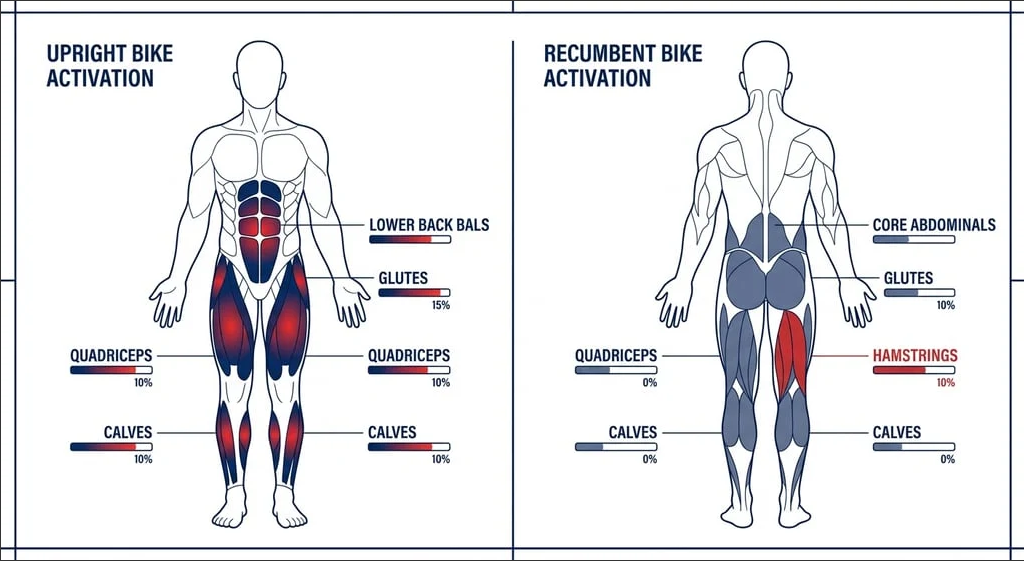
A common misconception is that recumbent trikes offer a lesser workout. Biomechanical studies show that recumbents engage major muscle groups just as effectively — they simply shift the workload and eliminate core stabilization drag. Because your back is fully supported, 100% of your force can translate into pedal output rather than being wasted on balancing the frame.
Biomechanical Differences
- Gluteus Maximus: Traditional upright bikes offer moderate engagement, increasing only when standing. On a recumbent trike, glutes become the primary driver pushing forward against the seat.
- Quadriceps: On upright bikes, quads are the primary driver during the downward pedal stroke. On recumbents, they sustain engagement across the full horizontal extension.
- Hamstrings: Upright riders mainly use hamstrings during the pull-up phase. On recumbents, hamstrings are actively engaged to stabilize extended leg movement.
- Core & Upper Body: Traditional cycling demands high isometric tension to stabilize the frame and handlebars. On a recumbent trike, core tension drops dramatically because the seat provides the support.
The "Recumbent Legs" Phase
When switching from an upright bike to a trike, riders often experience faster fatigue in their glutes and quads during the first few weeks. Because your back is braced firmly against the seatback, your leg extension acts like a leg-press machine at the gym. Once your body adapts to this isolated push — a phase known as getting your "Recumbent Legs" — endurance over long distances increases significantly.
3. Stability & Mental Strain
Physical comfort is closely linked to cognitive fatigue. Upright bikes require constant balance adjustments, particularly at low speeds or on steep climbs. Stopping at traffic lights requires unclipping and balancing on one foot. Recumbent trikes remove this mental load entirely.
- Upright Bike: Requires constant balance adjustments, especially at low speeds or on steep climbs. Stopping at traffic lights requires unclipping and balancing on one foot.
- Recumbent Trike: The three-wheel base provides inherent static stability. You cannot tip over at low speeds, you can pause midway up a steep hill without unclipping, and you stay fully relaxed at complete stops.
Summary Verdict: Upright vs. Recumbent Trike
- Perineal & Saddle Pressure: High risk of pain and numbness on upright bikes vs. virtually zero pressure points on a recumbent trike.
- Neck & Shoulder Strain: High on upright bikes due to hyperextended neck posture vs. zero strain on a recumbent with neutral posture.
- Wrist & Hand Fatigue: High on upright bikes due to weight-bearing handlebars vs. zero fatigue on a recumbent with a relaxed grip.
- Low-Speed Balance: Requires active balance on upright bikes vs. 100% self-stabilizing on a recumbent trike.
For riders focused on long-distance touring, pain-free exercise, or recovering from back, neck, or joint issues, the recumbent trike fundamentally solves the structural ergonomic flaws of the traditional bicycle. The combination of better posture, zero saddle pressure, and stable three-wheel geometry makes every ride longer, smoother, and more enjoyable.
Comfort is not a luxury on a recumbent trike — it is the engineering result of better biomechanics.
Ride the difference yourself
OVELOX is a low step-through electric recumbent trike built for comfort, stability and pain-free long rides — designed with seniors and pet families in mind.
Contact OVELOXKeep reading
How Cycling Can Become Part of Your Weekend Routine
Learn how to build a sustainable weekend cycling routine with an electric recumbent trike. Discover route ideas, distance goals, safety checklists, and tips for seniors, pet families, and active-aging riders.
Electric Trike vs Mobility Scooter: Which Is Better for Seniors?
Compare electric trikes and mobility scooters for seniors: stability, comfort, exercise, range, speed, terrain, cargo, storage, and everyday lifestyle. Find the right active mobility choice.